
Your phone rings, a patient is comparing dental offices, and the first thing they do isn't click through ten blue links. They ask Google a direct question, then they ask ChatGPT the same thing in a different way, then they check Perplexity for a short list of providers. If your practice shows up in one place but not the other, you're visible to half the buyer journey and missing the rest.
That's why answer engine optimization vs generative engine optimization matters. The two strategies overlap, but they don't behave the same way, they don't surface in the same places, and they don't prove value with the same metrics. For service businesses, the mistake is treating them like synonyms when they're really two different visibility jobs.
| Criterion | AEO | GEO |
|---|---|---|
| Primary target | Extracted answers in Google AI Overviews, featured snippets, People Also Ask, knowledge panels, and voice responses | Citable inclusion inside generative answers from ChatGPT, Perplexity, Claude, and Gemini |
| Best KPI | Snippet or AI Overview presence | Citation share of voice on a fixed prompt set |
| Content shape | Concise, direct, answer-first | Context-rich, reference-worthy, entity-clear |
| Technical emphasis | Schema markup, Q&A blocks, snippet-friendly formatting | Semantic HTML, topical hubs, internal linking, broader authoritative context |
| Time to notice change | Often faster after restructuring | Can be faster in retrieval systems, slower in training-based systems |
Table of Contents
- Why the Search Landscape Shifted
- Answer Engine Optimization Compared to Generative Engine Optimization
- Technical Implementation Requirements for Each Approach
- The Measurement Gap and How to Prove Results
- Use Cases for Service Businesses and Local Practices
- Implementation Roadmap for Service Businesses
- Recommendation for Service-Focused SMBs
Why the Search Landscape Shifted
A homeowner looking for an HVAC repair company used to scan a list of results, compare a few domains, and call the one that felt safest. Now that same person may ask Google for a direct answer, ask a chatbot for the “best” option, then check a map result or an AI summary before ever opening a website. That split is why AEO and GEO need separate labels.
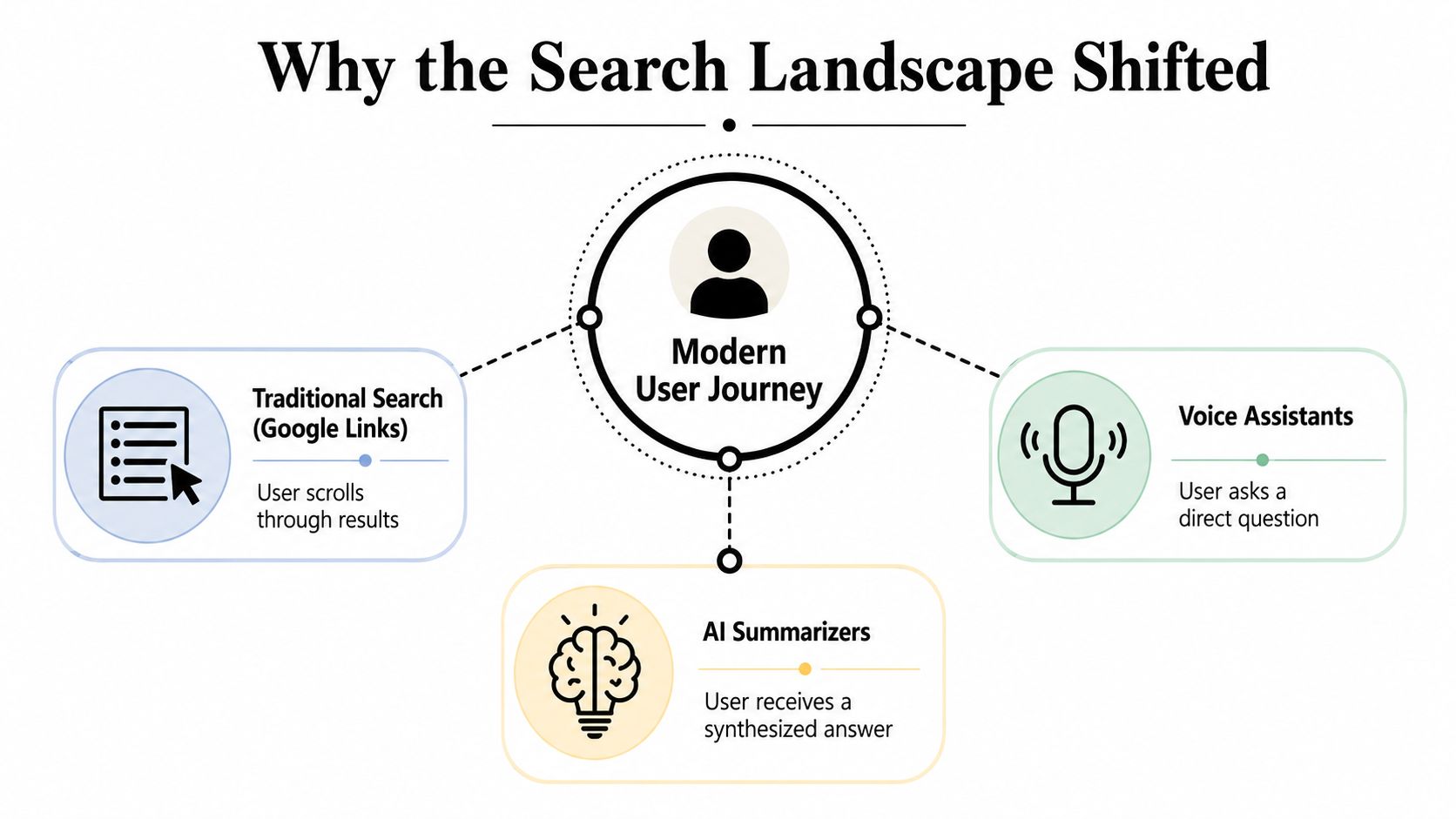
The distinction starts with the surface. AEO is built to win extracted answers in search engines, including Google's AI Overviews and voice assistants. GEO is aimed at visibility inside generative systems such as ChatGPT, Perplexity, Claude, and Gemini, which is the core distinction covered in AI SEO overview. The same buyer can move across all of those surfaces in one research session, and that creates different requirements for what gets seen, quoted, or ignored.
Traditional search still dominates behavior, since Google holds 90.82% search market share according to OmniBound's AEO statistics roundup. The AI layer is no longer fringe behavior. One roundup cites 2.5 billion daily prompts for ChatGPT, and another reports Perplexity at 780 million searches per month, up from 230 million in August 2024. Those numbers explain why marketers started using separate terms for extractive answers and synthetic summaries.
Practical rule: if your audience asks short, direct questions, you need extractable content. If they ask comparative, research-heavy questions, you need content that AI systems can trust, summarize, and cite.
The user journey now spans traditional links, voice assistants, and AI summarizers. For service businesses that need to show up in more than one place, that means search strategy is no longer just about ranking pages. It is about deciding which query types should be won with concise answers, and which ones need depth, proof, and enough context for a model to use.
Answer Engine Optimization Compared to Generative Engine Optimization
A local service page can do one job well and still miss the other. AEO is built to win the extracted answer, such as a featured snippet, a People Also Ask result, a knowledge panel, or a spoken response. GEO is built to earn citable inclusion inside a generated response, where the model names or references a source as part of its synthesis, as explained in Stackmatix's AEO vs GEO comparison.
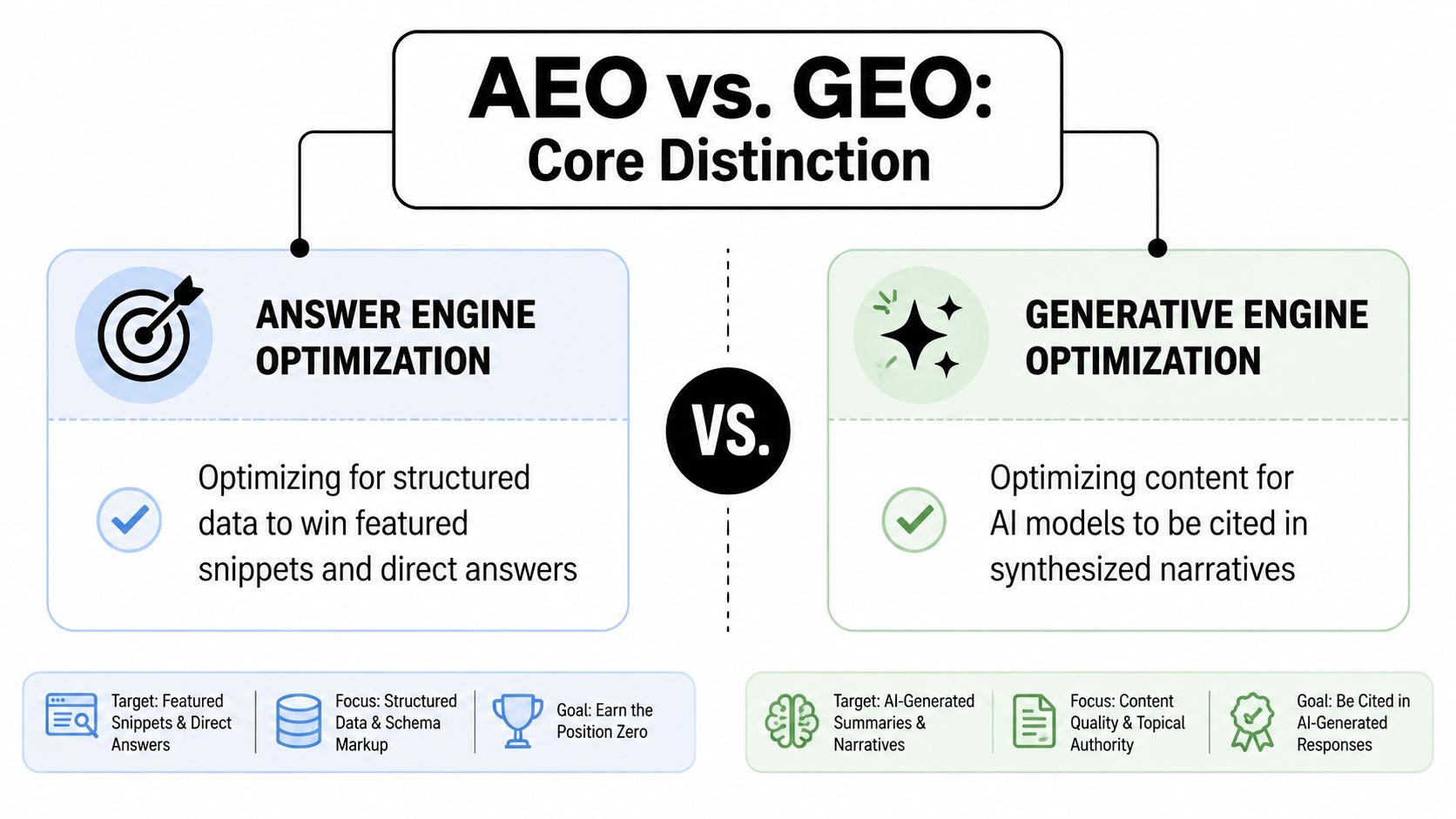
That split matters in practice. A service business can build a page that wins an answer box and still fails to show up inside a chatbot summary, because the page is too thin for a model to trust. The reverse also happens. A detailed, authoritative page can get cited in Gemini or Perplexity and still never produce a clean snippet because the page does not present the answer in a format that can be lifted cleanly.
Measurable output separates them
AEO is easier to judge because the result is visible. You can check whether a query triggers an answer box, whether your page is cited, and whether the result appears in a direct answer surface. GEO is harder to pin down because the user may get a synthesized response without a conventional ranking position showing at all.
| Criterion | AEO | GEO |
|---|---|---|
| What it tries to win | Direct answers | Citations inside synthesized responses |
| Where it shows up | Featured snippets, AI Overviews, voice, knowledge panels | ChatGPT, Perplexity, Claude, Gemini |
| Best signal of success | Presence in the answer surface | Citation share on a prompt set |
| What the user sees | A concise answer pulled from content | A model-generated summary with sources or references |
| Common failure mode | Being too long or unfocused for extraction | Being too thin or generic to be reference-worthy |
| Primary optimization cue | Clear, answer-first formatting | Entity clarity, source trust, topical coverage |
| Best content shape | Short answer blocks, FAQs, definitions | Hub pages, support pages, source-rich explanations |
AEO can make you visible quickly, but it can also trap you in shallow content if you stop there. GEO asks for more depth, more context, and more proof.
Agencies still collapse these into one bucket, which hides the operational difference. If a clinic only optimizes for snippets, it can miss the broader AI conversation. If a law firm only optimizes for model citations, it can stay absent from the direct-answer surfaces that drive a lot of local and voice discovery.
Why service businesses should care about both
Local and regulated categories do not get the same value from each surface. A patient may ask a short, direct question such as “what's a root canal?” and an AI Overview can handle that immediately. The same patient may later ask which clinic looks most trustworthy, and that is where GEO-style reference quality matters more than a single snippet.
Service businesses should match the surface to the query. Direct questions need extractable content, while comparison and trust questions need citable depth. That choice affects how pages are written, how proof is presented, and how success is measured across both channels.
Technical Implementation Requirements for Each Approach
AEO and GEO share a technical base, but they reward different page structures. Service businesses lose time when they treat that as a single checklist. They add markup everywhere, strip pages down until the copy loses meaning, then wonder why AI surfaces still ignore the brand.
What AEO needs on the page
AEO works best when a page is easy to extract. That means schema markup, Q&A blocks, concise paragraphs, and formatting that lets a single answer stand on its own. If the core question is “How long does a dental cleaning take?”, the answer should appear in a short block of text, not inside a long explanation of your practice philosophy.
The discipline matters. Every service page should include a clear answer section, not only a sales pitch, and every FAQ should sound like the way a real patient asks the question. If the page reads like marketing copy first and information second, answer engines have to work harder than they should.
What GEO needs to trust and cite you
GEO leans on semantic HTML, topical hubs, internal linking, entity clarity, and broader authoritative context. That does not mean bloating pages. It means making it easier for an LLM to understand who you are, what you cover, and why your page belongs in a summary about the topic. The content has to feel reference-worthy, not just searchable.
Site architecture matters here. A topical hub around a service line, linked to supporting pages, gives the model stronger context than a pile of disconnected landing pages. AI systems read patterns more cleanly when the site's entities, services, authors, and supporting evidence line up in a clear structure.
Rule of thumb: AEO compresses. GEO contextualizes. If the page only does one of those things, it will underperform somewhere.
Industry guidance also points to different timing. AEO changes can show up within days to weeks after restructuring, while GEO in retrieval-based systems may react in days but training-based models can take months to reflect changes Archetype's AEO vs GEO guide. That makes AEO the faster visibility play in many cases, while GEO behaves more like an authority investment.
For teams managing both, I would fix the fundamentals first, then separate the content jobs. If a page is meant to answer a direct question, write it for extraction. If it is meant to support citations across AI systems, give it depth, entity clarity, and internal links that make it part of a larger subject cluster.
Site structure decisions matter as well. The subdirectory vs subdomain guide is relevant here because authority flows differently across those setups, and that affects how you build topical coverage for both search engines and generative systems.
The Measurement Gap and How to Prove Results
A service business can do the right AEO and GEO work and still struggle to prove it if the measurement model is weak. Teams know they should track AI visibility, but that phrase stays vague until it is tied to leads, calls, and booked work. Rankings alone will not tell you whether a practice is being recommended in an AI answer, cited in a generative summary, or helping produce a later conversion.
Why traditional ranking KPIs fall short
A 2024 industry study found that about 60% of Google searches ended without a click in the U.S. and E.U. Siteimprove's readiness assessment. Classic ranking reports are less useful as a proxy because a user can get what they need without landing on your page. The same issue shows up across AI-mediated discovery, where a person may research, compare, and shortlist before any visit happens.
That shift requires a different dashboard. You need to know whether your brand appears in the answer, not just whether you rank for the keyword. You also need to know whether the user who clicks is coming from a direct answer environment, a cited AI summary, or a later branded search.
A practical measurement framework
The framework I use with service businesses is simple, even if the tooling behind it is not. Track answer-share presence, citation frequency, and assisted conversions. Those three signals show whether AEO or GEO is doing real work, even when the path to lead is not linear.
- Answer-share presence: check whether your brand appears in direct answer surfaces for your highest-value questions.
- Citation frequency: monitor how often AI platforms cite your page or mention your business in generated responses.
- Assisted conversions: compare leads that follow AI research with leads that come from standard organic discovery.
If your contact form never asks how someone heard about you, you are undercounting the channel that introduced them.
The point is not perfect attribution. It is directional truth. A practice that appears often in AI answers but never gets credited in reports still has a discovery problem, not a visibility problem. A business that gets cited in generative responses but does not see downstream calls may have a trust issue or a conversion issue, not a ranking issue.
AISEOGrow's AI rank tracking resource fits naturally into this measurement gap because the core task is to observe presence across Google, AI Overviews, and major LLMs, then connect that to lead quality instead of vanity visibility. Use the AI rank tracking guide to see how that tracking setup works in practice.
Use Cases for Service Businesses and Local Practices
A dentist, a lawyer, and a home service company can all benefit from AEO and GEO, but they shouldn't weight them the same way. The right priority depends on the query profile, how much trust the category requires, and whether the buyer is usually looking for a quick answer or a longer comparison.
When AEO should lead
For a local dentist, AEO usually deserves the first pass. Patients often ask direct questions about procedures, pain, timing, and insurance, and those are the kinds of queries where concise answer blocks, schema, and service clarity can pay off quickly. A strong Google Business Profile, clean service descriptions, and a tightly written FAQ section can make the practice easier to extract in direct-answer surfaces.
The same logic applies to many home service companies. If someone asks “how fast can a plumber come out?” or “do you offer emergency repair?”, the answer needs to be unambiguous. AEO supports that behavior better than a long-form authority play does.
When GEO should take more of the budget
A law firm in a crowded market usually needs more GEO weight. People researching legal services ask comparison questions, credibility questions, and “which firm should I trust?” questions, and those queries reward clearer entity signals, stronger author bios, and more proof across the site and the broader web. A generic page about practice areas won't carry much weight in a generative summary if the model can't tell why that firm is the right reference.
Medical clinics sit somewhere in the middle. They often need AEO for direct patient education, but GEO becomes more important when the query turns into credibility, specialization, or care pathways. In regulated categories, the business has to show who is behind the content, what credentials they hold, and why the information should be trusted.
A quick decision rule
- Choose AEO first when the query is local, immediate, and direct.
- Choose GEO first when the query is comparative, high-trust, and research-heavy.
- Use both when the category has enough search volume to justify separate content jobs.
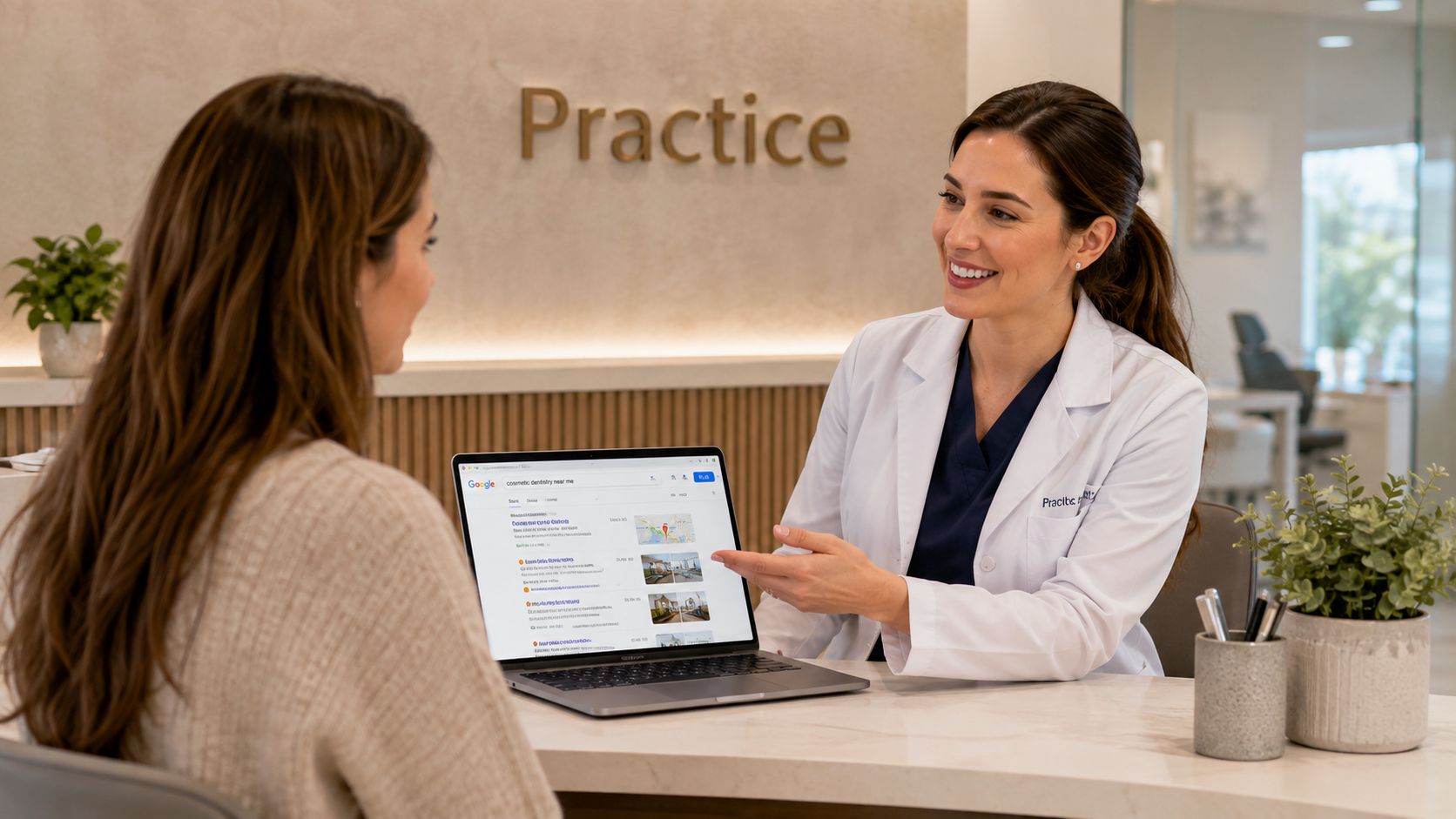
A local practice doesn't need to become an AI publication. It needs to answer the questions people are asking, then prove enough authority that AI systems feel comfortable citing it. That's a different job from classic SEO, and it's also different from trying to game one platform at the expense of the others.
Implementation Roadmap for Service Businesses
The fastest way to get stuck is to optimize content before you know what's missing. Start with visibility, then fix the technical base, then rewrite the content that matters most. That sequence works because it prevents teams from spending weeks polishing pages no one can see.
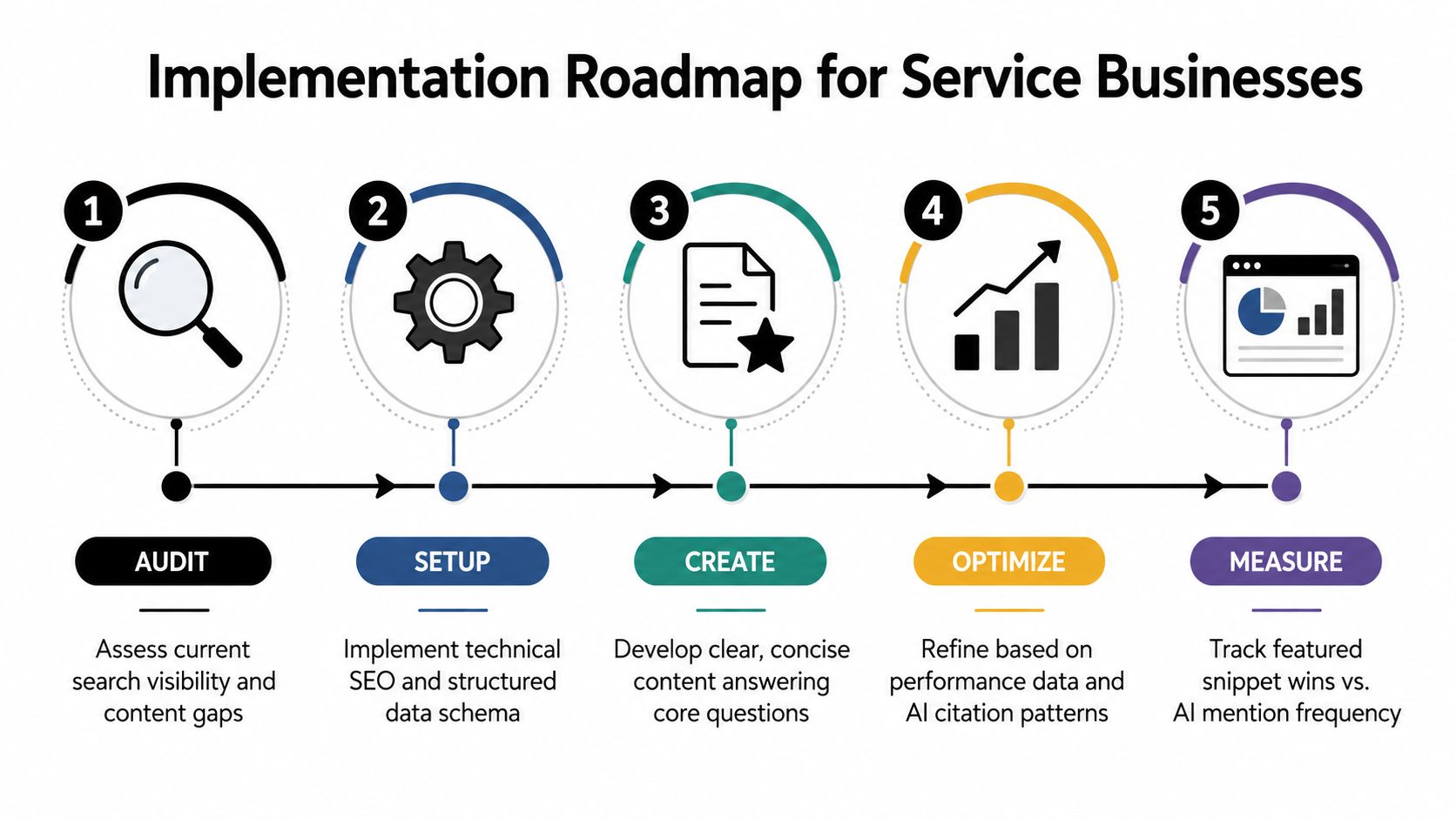
Step 1 Audit visibility first
Run a visibility audit across Google, AI Overviews, and major LLM platforms. Look for the queries where your business appears, the ones where competitors appear instead, and the ones where no one credible is being surfaced. That tells you whether you're dealing with a direct-answer gap, a citation gap, or both.
Step 2 Fix the shared technical base
Clean up schema, entity consistency, crawlability, and page speed. These fixes help both AEO and GEO, so they're the most impactful work early on. If crawlers can't interpret the page cleanly, the rest of the strategy is trying to operate on a weak foundation.
Step 3 Restructure the right pages
Take the most important service pages and make them easier to answer from. For AEO, lead with direct questions and short answers. For GEO, add supporting context, internal links, credentials, and proof that makes the page reference-worthy.
Step 4 Build a measurement routine
Use the same prompt set every week for your highest-value topics. Track whether your brand shows up, how it's described, and whether visibility changes after content updates. The goal is consistency, not perfection.
Step 5 Treat AI visibility as an ongoing process
Search behavior keeps moving, so a one-time rewrite won't hold. Teams that monitor answer surfaces and citation patterns regularly are in a better position to adjust content before competitors catch up. That's also where tools can help, including AISEOGrow's audit and implementation services for service-based businesses that need to cover technical SEO, structured data, content optimization, and local AI visibility in one plan.
Later in the process, a short check-in with your sales team can tell you whether the visibility work is turning into real buyer interest. The best feedback often comes from the questions prospects ask after they've already done some AI-assisted research.
Recommendation for Service-Focused SMBs
Service-focused SMBs shouldn't choose between AEO and GEO as if one cancels the other out. They should build both, but not with equal weight. If your business depends on direct-question traffic, local intent, and quick decisions, front-load AEO because it can produce faster visibility in the surfaces customers use first.
If your category is built on trust, comparison, and longer evaluation cycles, push harder on GEO. Citation authority compounds, and once a competitor owns the narrative in AI summaries, it's harder to dislodge them than to win a snippet. That's especially true in regulated and high-consideration markets.
The smart move is a phased blend. Start with the pages that answer immediate questions, then build the topical depth and entity clarity that make your brand reference-worthy. The businesses that win won't be the ones that picked a side, they'll be the ones that matched their content to the way people search.
If you want a practical plan for that mix, AISEOGrow helps service businesses audit visibility, tighten technical foundations, and structure content for both direct answers and generative citations. Visit AISEOGrow to review how their AI SEO and answer engine optimization work connects to your site, then use that baseline to decide where AEO or GEO should come first.