
You've published the service page, earned respectable blue-link rankings, and watched Google place an AI-generated answer above the results. The searcher may get a useful summary without visiting any page at all. Your brand can still gain visibility, but the winning position has changed. It's no longer enough to rank near the top. Your page needs to be understandable, trustworthy, and easy for Google to cite inside the answer.
That's the practical challenge behind how to optimize for AI Overviews. The work resembles SEO in places, but the operating model is different. You're competing for a small citation pool inside a volatile, increasingly zero-click answer layer. The process requires structured answers, clear business entities, commercial and navigational coverage, and ongoing citation monitoring.
Table of Contents
- Why AI Overviews Changed What Optimization Means
- How AI Overviews Choose and Cite Sources
- Structuring Content So Answers Are Easy to Extract
- Building Entity Authority and Schema That Models Trust
- Testing Prompt Coverage and Monitoring Citation Performance
- Putting Your AI Overview Optimization Plan Into Action
Why AI Overviews Changed What Optimization Means
A patient at a Chicago orthodontic practice searches “how long does Invisalign treatment take.” Google may present a synthesized answer above the traditional results, drawing from several pages before the patient visits any clinic site. The law firm Smith & Jones, when someone searches its name, may appear in an answer describing its services, location, and reputation. A homeowner comparing roofing companies can receive enough guidance to end the search without clicking.
Google launched AI Overviews in the United States on May 14, 2024, after testing the feature as Search Generative Experience in 2023. The rollout added an answer layer to the results page, allowing an AI-generated summary to appear above organic listings. Google's AI Overviews history and rollout documents that development.
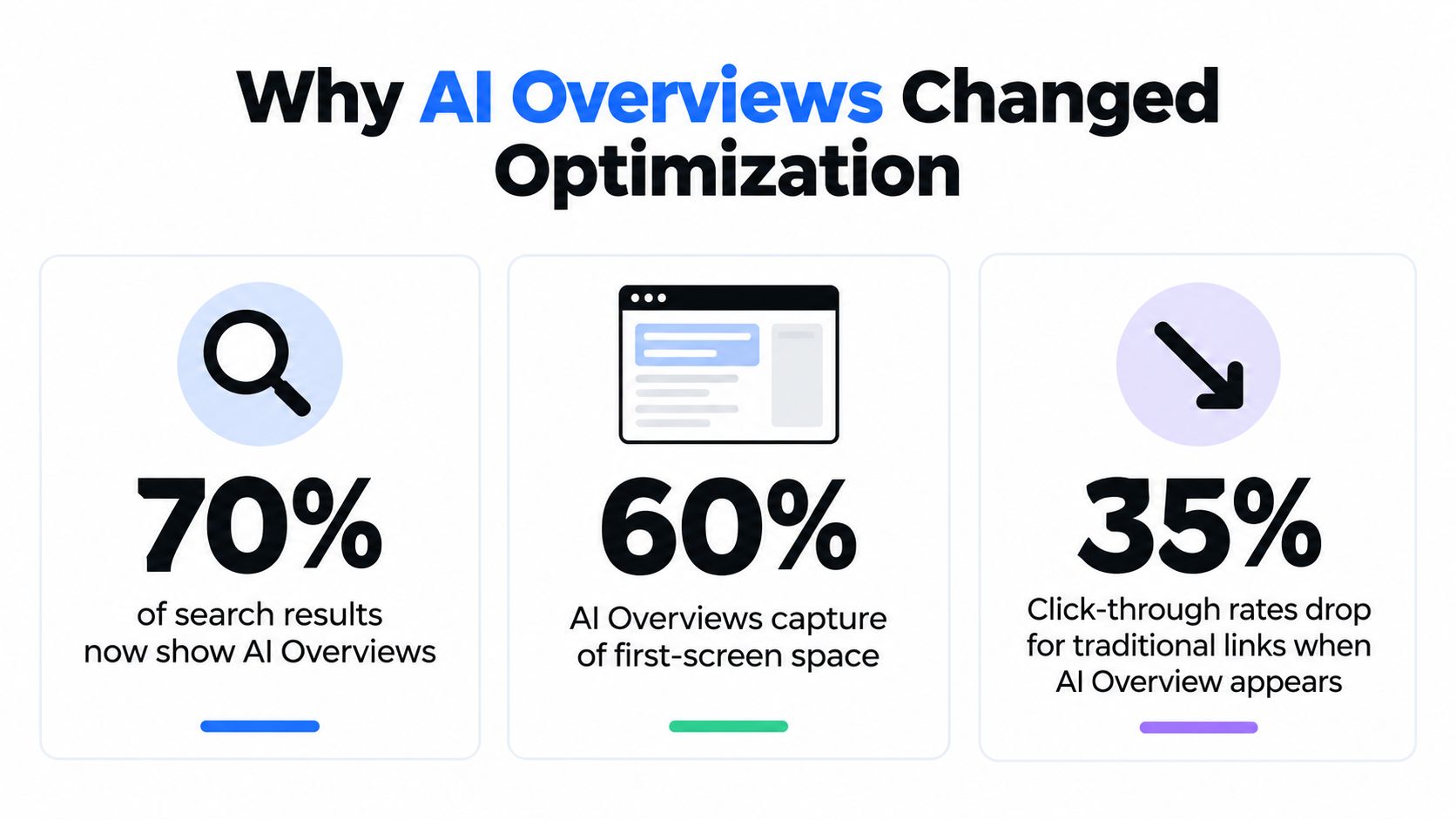
The screen-space effect can be substantial. When AI Overviews and featured snippets appeared together, they occupied about 67.1% of desktop screen space and 75.7% on mobile in December 2024, according to the cited rollout analysis. A page can retain a strong organic position while receiving less attention because the generated answer appears first and fills the searcher's initial view.
Visibility now has several layers
Classic SEO measures whether a page ranks and earns a visit. AI Overview optimization adds four practical checks:
- Answer presence: Does Google mention the brand, service, or recommendation?
- Citation presence: Does the overview link to the page as supporting evidence?
- Entity association: Does the answer connect the business with the correct service and location?
- Brand recall: Does the summary give the searcher a reason to remember the company?
Pew Research Center tracked 68,879 real Google searches from 900 U.S. adults and found that users clicked a traditional organic result on only 8% of visits when an AI Overview was present, versus 15% when it was absent. Citation links inside the overview received clicks on just 1% of visits. These findings appear in the behavioral analysis of AI Overview search activity.
Practical rule: Optimize for being selected and remembered, not only for generating an immediate organic session.
Clicks still matter for service businesses. Landing pages must convert visitors, demonstrate expertise, and support local discovery. The trade-off is that a visible citation can influence a buyer even when no immediate session follows. Track which commercial and navigational queries cite the business each week, then improve pages that earn neither citation nor action. The strongest plan combines answer-layer visibility with pages built for the next step when the buyer is ready.
How AI Overviews Choose and Cite Sources
An AI Overview doesn't just copy the first result. It interprets the query, identifies useful supporting pages, and compresses information into a short response. Your page must therefore satisfy two conditions at once. It needs to be relevant to the query, and its claims need to be presented in a form that a system can extract without losing context.
A useful evaluation model has three parts.
Start with query intent
A definitional query such as “what is a root canal” needs a direct explanation. A how-to query such as “how to prepare for a court hearing” needs ordered guidance. A comparison query needs distinctions, qualifications, and decision criteria. The page format should follow the question rather than forcing every query into a blog post.
A 1,000-overview citation analysis found that definitional and how-to formats averaged 5.6 citations per overview, making them structurally attractive to answer sets. The same analysis found that the average overview cited 4.2 sources, while a small group of highly cited domains captured a large share of citations. See the AI Overview citation-pattern analysis for the methodology and findings.
Make the answer self-contained
A citation-worthy passage usually works without three paragraphs of setup. It identifies the subject, gives the answer, and adds the qualification that prevents misunderstanding. For a dental practice, “Invisalign treatment uses a sequence of clear aligners to move teeth gradually” is more extractable than a vague opening about modern smiles.
Strong answer blocks commonly include:
- A query-matched heading that states the user's question.
- A concise answer that resolves the question directly.
- A qualification covering eligibility, exceptions, cost factors, or location.
- Supporting evidence such as credentials, process details, references, or firsthand expertise.
- A logical next step leading to a relevant service or contact page.
Reinforce the page with organic strength
AI Overview visibility isn't an isolated channel. One analysis found that 52% of cited sources also ranked in the top 10 organic results, which supports a practical conclusion: strong conventional SEO remains part of the citation strategy. Research on AI Overview coverage and source characteristics connects organic visibility with answer-layer inclusion.
The pages most often ignored are broad, repetitive, and difficult to verify. They make sweeping claims without identifying the business, author, service, audience, or evidence behind them. Clear structure helps extraction, but structure can't compensate for weak relevance or an unclear entity.
A page-level audit should ask: Can a reader understand the answer from one passage? Can Google identify who wrote it, which business it represents, and what query it addresses? Can another source corroborate the important claims?
For a broader framework connecting search visibility with answer selection, review answer engine optimization principles.
Structuring Content So Answers Are Easy to Extract
The most effective content improvements usually happen at the page architecture level. Don't begin by adding more paragraphs. First decide which query the page owns, what answer it must provide, and where that answer should live.
Create one canonical answer for each intent
A service business often spreads the same explanation across its homepage, service page, blog, and FAQ. That creates internal competition and makes it less obvious which URL should represent the business for a specific question. Choose one canonical page for each important intent, then use supporting pages to deepen the topic and link back to that source.
For example, an orthodontic practice might assign:
- “What is Invisalign?” to an educational guide.
- “Invisalign treatment” to the primary service page.
- “Invisalign orthodontist in [location]” to a local service page.
- “Practice name Invisalign” to the brand or treatment page that clearly identifies the practice.
The pages can reference one another, but they shouldn't repeat identical explanations. Use internal links to clarify relationships, not to distribute several competing versions of the same answer.
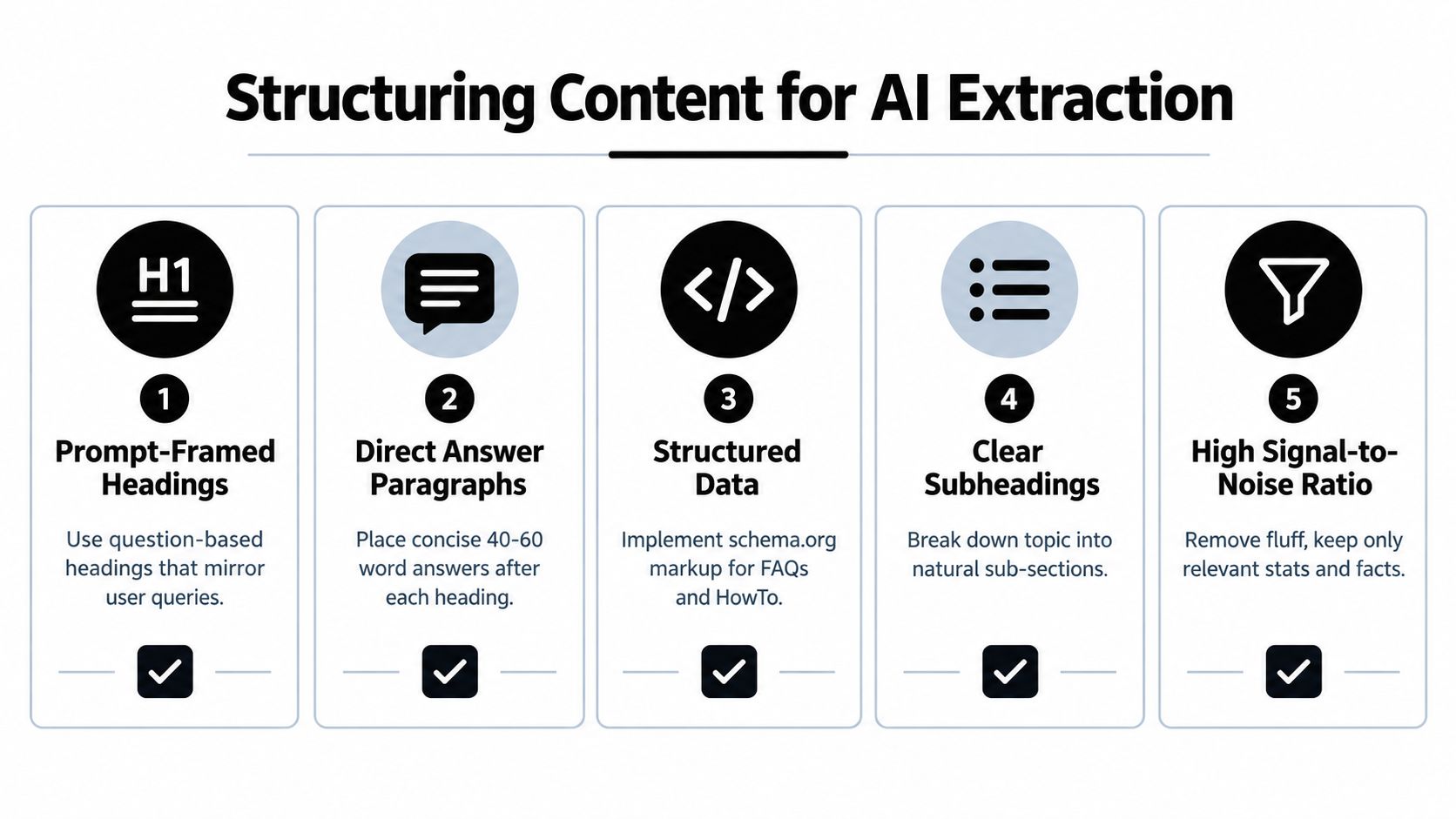
Use prompt-framed headings
Write headings in the language customers use. "Treatment considerations" is less precise than "How long does Invisalign treatment take?" A question heading establishes the retrieval target and gives the following paragraph a clear job.
After each heading, place a direct answer before expanding into detail. Keep the passage compact enough to stand alone, then add examples, limitations, or process information underneath. The brief's recommended answer-block range is 40 to 80 words, with the shorter end often working well for simple definitions and the longer end for qualified service explanations.
A useful block looks like this:
How long does a first legal consultation take?
A first consultation gives the attorney time to understand the facts, identify immediate risks, and explain possible next steps. The exact agenda depends on the legal issue and the documents available, so prospective clients should bring relevant notices, contracts, or correspondence when possible.
That paragraph answers the question, names the professional, and avoids promising an outcome. The page can then explain preparation, eligibility, fees, and what happens afterward.
Match format to intent
Commercial and navigational queries need more than FAQ content. A service page should describe the service, audience, process, differentiators, qualifications, location, and conversion path. A brand page should make the relationship between the business, people, services, offices, and official profiles unambiguous.
| Query Intent | Best Page Type | Answer Format | Internal Linking Priority |
|---|---|---|---|
| Informational | Definitive guide or resource page | Direct definition, steps, qualifications, evidence | Link to the relevant service and supporting resources |
| Commercial | Service or comparison page | Who it's for, what's included, process, decision factors | Link to provider, location, proof, and contact pages |
| Navigational | Brand, provider, or location page | Official identity, services, address, contact details | Link to primary services and verified profiles |
| Local service | Location-specific service page | Service explanation, geography, availability, trust signals | Link to local proof, team, and booking pages |
Don't hide the answer in accordions if the visible page needs to communicate the core meaning. FAQ sections can support users, but a page built from dozens of nearly identical questions often produces duplication without adding authority.
Use schema to mirror the visible content
Structured data helps machines interpret page content, but it shouldn't introduce claims that visitors can't see. Add schema that reflects the page's actual subject, service, organization, person, location, or process. Then validate it and compare the markup with the rendered copy.
The schema markup guide for AI search is useful when you're deciding how to connect on-page answers with structured entities. Schema won't force an AI Overview citation, and it won't rescue an unclear page. It can reinforce a coherent page when the visible content, metadata, and business information all agree.
Finish by editing for signal density. Remove generic introductions, repeated service descriptions, unsupported superlatives, and paragraphs that don't help answer the target query. A concise page with clear evidence is easier to understand than a longer page padded with interchangeable marketing language.
Building Entity Authority and Schema That Models Trust
A well-structured answer can still be ignored if Google can't establish what the business is, which services it provides, where it operates, or whether the page represents the official source. Entity authority is the trust layer connecting those facts.
For a local law firm, the entity should connect the firm name, attorneys, practice areas, office location, phone number, official website, and external references. For a medical clinic, the same system should connect the organization, clinicians, specialties, facilities, accepted services, and geographic coverage. The goal isn't to add every possible schema type. The goal is to make the business consistently recognizable across its digital footprint.
Build consistency across business surfaces
Start with the facts customers and search systems use to identify the company:
- Business identity: Use the same official business name across the website, Google Business Profile, directories, and professional references.
- Service vocabulary: Define services consistently instead of switching between vague promotional labels.
- Geography: State the actual office, service area, and relevant neighborhoods or regions.
- People: Identify practitioners, attorneys, clinicians, or technicians with role-specific biographies.
- Proof: Connect credentials, memberships, awards, reviews, publications, and professional mentions to the correct organization or person.
A mismatch doesn't always disqualify a page, but it creates ambiguity. If the website calls a service “emergency dental care,” the profile says “urgent appointments,” and the schema describes something unrelated, the signals don't reinforce one another.
Align schema with the page
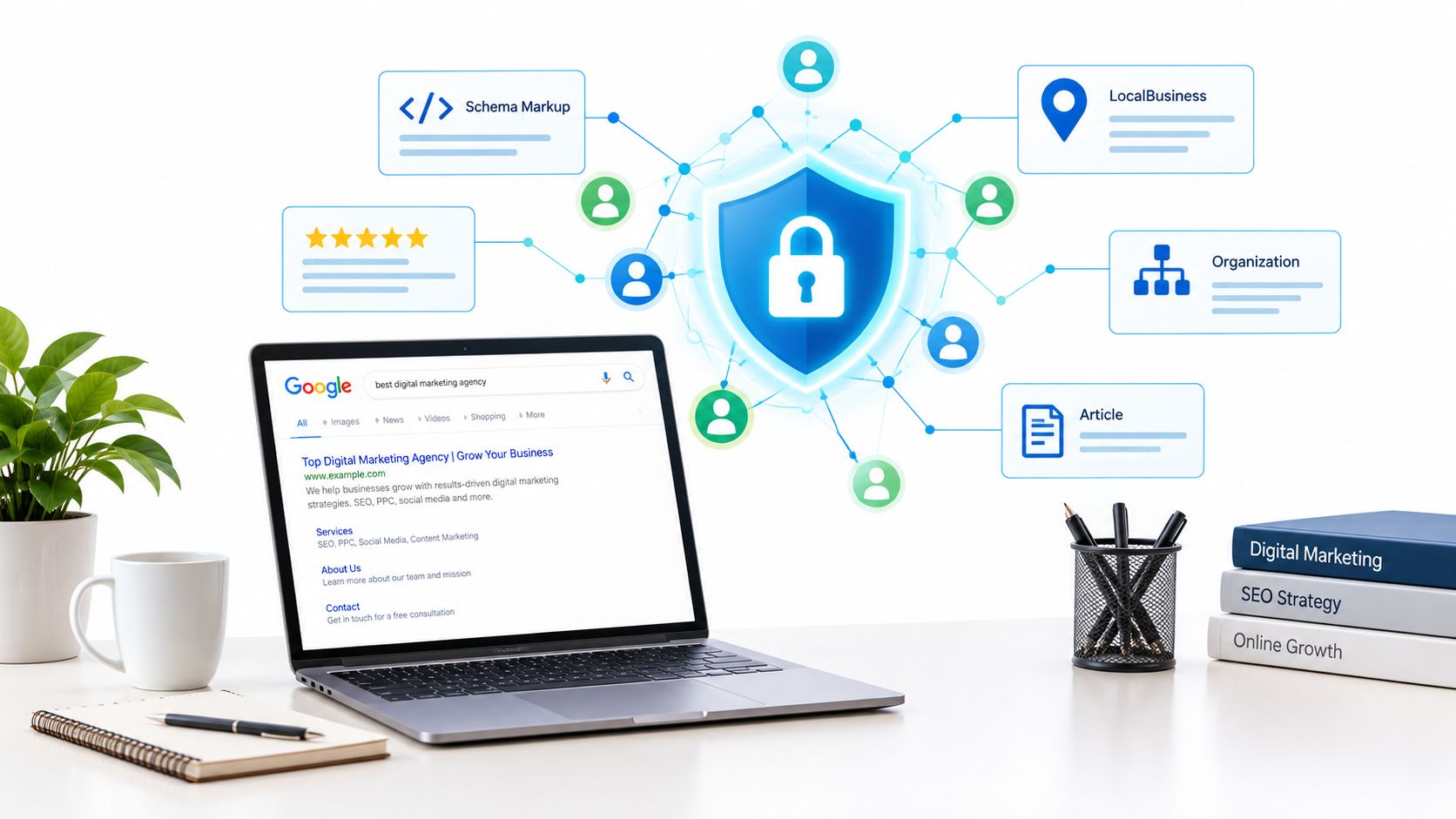
Use Organization, LocalBusiness, Service, Person, and location relationships where they accurately represent the business. Use FAQPage or HowTo only when the visible page contains the corresponding questions or steps. Keep names, URLs, addresses, service descriptions, and relationships synchronized.
Avoid stuffing schema with unsupported ratings, locations, or service claims. Structured data should model the page, not act as a hidden advertising layer. Validate the implementation, inspect how it renders, and check whether the markup describes the canonical URL rather than a duplicate or outdated version.
Entity relationship mapping can help teams document how the organization, people, services, locations, and supporting sources connect. That map is especially useful for service businesses with multiple offices or practitioners, where inconsistent relationships create avoidable ambiguity.
Trust signals work together. A clear service definition, consistent business identity, and corroborating reference are stronger as a system than as isolated additions.
The same discipline supports visibility beyond Google. ChatGPT, Gemini, and Perplexity also need enough context to distinguish an official provider from a similarly named business or a generic directory entry. No schema field guarantees selection, but coherent entity signals make the page easier to interpret and reference.
Testing Prompt Coverage and Monitoring Citation Performance
Optimization becomes more reliable when you treat it as an observation system instead of a one-time content refresh. AI Overview coverage changes by query, device, market, and time, so a single audit can't tell you whether a page has durable visibility.
Semrush reported U.S. desktop AI Overview coverage moving from 6.49% in January 2025 to 13.14% in March, peaking near 24.61% in July, then falling to 15.69% by November. Independent summaries have also reported broad variation, from roughly 4.5% to 30%, depending on country, device, and query set. The volatility findings are documented in the Semrush AI Overview study.
Build a representative prompt set
Create a working set of queries for each important service line and location. Don't limit the set to informational questions. Include:
- “What is” and “how does” questions.
- Service-selection and comparison queries.
- Provider, brand, and office-name searches.
- Location-specific queries.
- Questions involving eligibility, process, risks, and alternatives.
Record the exact wording, market, device, date, and language. The same business can appear for one phrasing and disappear for a close variation, so casual manual searching won't produce a dependable baseline.
Track the answer, not only the rank
For every prompt, record whether an AI Overview appeared, which brands were mentioned, which pages were cited, and whether the answer accurately represented the business. Track organic position separately. A page can rank well without being cited, or be cited for a query where its organic position isn't the primary focus.
Useful weekly fields include:
| Field | What it reveals |
|---|---|
| Overview presence | Whether the answer layer appeared for the prompt |
| Brand mention | Whether the business entered the answer narrative |
| Citation URL | Which page Google selected |
| Citation position | Whether the page appeared among the visible sources |
| Intent category | Which query type produces visibility |
| Market and device | Where the result is reproducible |
| Accuracy notes | Whether the summary describes the service correctly |
Weekly tracking is more useful than a one-time snapshot because it exposes volatility. Segment reports by informational, commercial, navigational, and local intent. If informational pages are cited but service pages aren't, the content problem is probably not general authority. It may be page type, entity clarity, or missing commercial answers.
Iterate from observed citations
When a competitor is cited for a query you care about, compare the answer block rather than copying the page. Look for differences in specificity, service definitions, author identification, evidence, location clarity, and internal linking. Then update the canonical page and watch the same prompt set over subsequent weeks.
Don't judge success only by traffic. Pair citation visibility with branded searches, assisted conversions, qualified inquiries, and organic performance. The right measurement model recognizes that answer-layer exposure can influence demand even when the overview satisfies the initial question without a click.
Putting Your AI Overview Optimization Plan Into Action
Start with the pages closest to revenue. For a service business, that usually means the primary service pages, location pages, provider pages, and brand queries before a large expansion of blog content. Give each important intent one canonical source, then make its answer visible, specific, and easy to extract.
A practical sequence looks like this:
- Inventory existing prompts: Group queries by informational, commercial, navigational, and local intent.
- Assign canonical pages: Decide which URL should represent each service, provider, location, and core question.
- Rewrite answer blocks: Put direct, qualified answers beneath prompt-framed headings.
- Repair entity signals: Align business facts, people, services, locations, profiles, and references.
- Validate schema: Make structured data match visible content and canonical URLs.
- Track citations weekly: Record overview presence, brand mentions, selected URLs, intent, market, and accuracy.
- Iterate selectively: Improve pages that are relevant but ignored, rather than publishing generic content at scale.
Prioritize clarity before volume. A smaller set of authoritative pages with distinct purposes is easier to maintain, measure, and connect than a library of overlapping articles. AISEOGrow applies this audit-led approach across Google AI Overviews and other answer engines, reviewing content, structured data, technical accessibility, and authority signals for service businesses.
AISEOGrow can audit your AI Overview visibility, identify citation and entity gaps, and implement answer-focused content, schema, technical SEO, and local AI search improvements. Visit AISEOGrow to request an AI SEO audit and turn your priority service pages into clearer, more reference-worthy sources.